Potentiostats and Galvanostats
Explore our comprehensive range of electrochemical workstations, from compact benchtop models to modular systems. We offer single-channel and multi-channel potentiostats/galvanostats, with built-in or optional Electrochemical Impedance Spectroscopy (EIS) functionality. Configurations include bipotentiostat options for advanced applications.

Single channel potentiostats
Choose freely between compact instruments, modular systems, or VIONIC – the premium all-in-one solution.
Explore our devices

Multi-channel potentiostats
High throughput with versatility: up to 12 channels per cabinet, controllable by up to 3 computers simultaneously.
Explore our devices
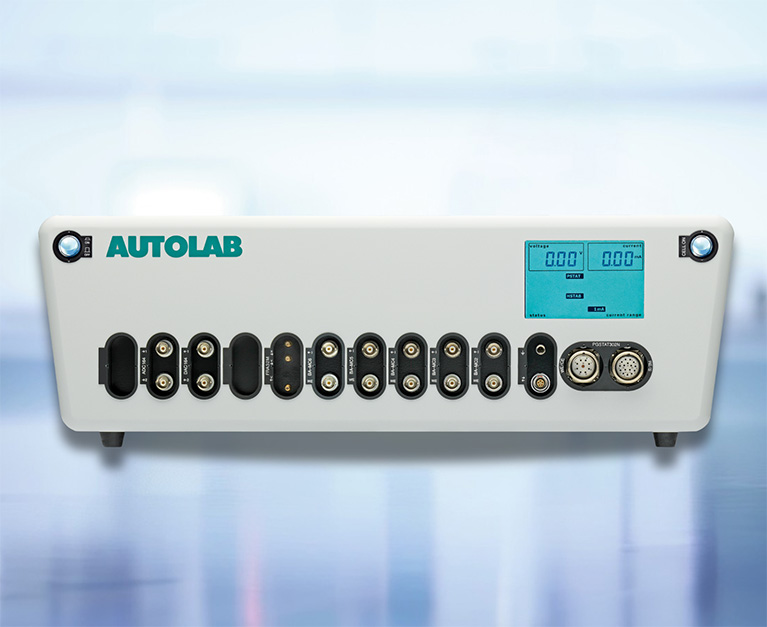
MultiBA
Potentiostat for parallel measurements on six working electrodes simultaneously, with one reference and one counter electrode within the same electrochemical cell.
Explore our devices
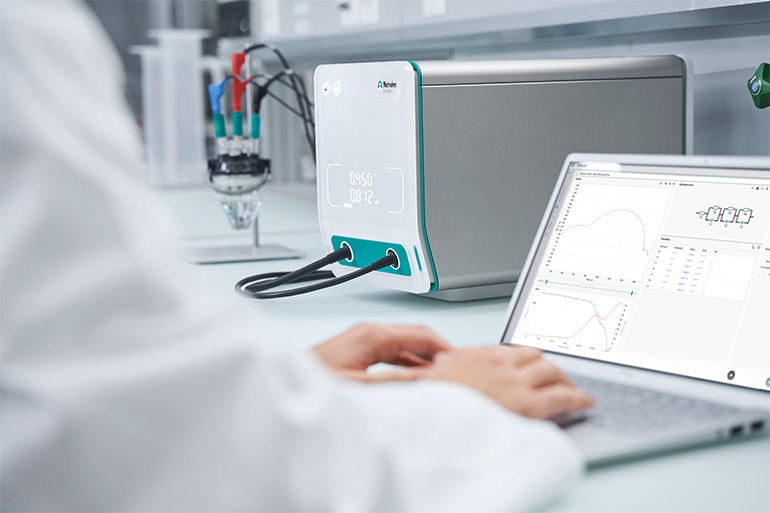
EIS - Electrochemical Impedance Spectroscopy
Electrochemical Impedance Spectroscopy (EIS) is a powerful technique used to characterize the electrical properties of electrochemical systems. EIS enables researchers to study reaction mechanisms, electrode kinetics, and interfacial properties by applying a small AC signal over a range of frequencies. It is widely used in battery research, corrosion studies, coatings evaluation, fuel cells, and sensor development in both fundamental and applied research.
Our potentiostats and galvanostats — both single-channel and multi-channel models — support high-precision EIS measurements, accuracy > 99.75%, frequency up to 10 MHz. With our smart software feature, you can analyze Nyquist plots, Bode plots, and fit equivalent circuits with confidence.
How to choose a suitable potentiostat?
Criteria 1: Single-channel or multi-channel
Determine if you need a single-channel potentiostat for one experiment at a time or a multichannel system for performing multiple experiments simultaneously. Multi-channel potentiostats are particularly advantageous for high throughput, long-duration measurements (e.g., battery charge-discharge, electrochemical sensor development) or for multi-user environments.
Criteria 2: Voltage and current range
Consider the range of potentials and currents you expect to work with.
Basic requirement: Compliance voltage up to ± 10 V, max current up to ± 100 mA
Small, lightweight and affordable.
Moderate requirement: Compliance voltage up to ± 20 V, max current up to ± 400 mA
Small and able to add one more module (e.g. EIS).
Advanced requirement: Compliance voltage up to ± 30 V, max current ±2 A (upgradeable 20A)
Customizable with a range of modules.
Stringent requirement: Compliance voltage up to ± 50 V, max current ±6 A
Highest specification in one instrument.
Criteria 3: Bipotentiostat
Consider a bipotentiostat if your research requires independent voltage control for two working electrodes placed in the same cell, enabling more complex experiments such as reaction intermediates detection or dual electrode setup. Typical applications include:
- Rotating Ring-Disk Electrode (RRDE) Experiments: Control the ring and disk electrodes separately to study reaction intermediates (e.g., oxygen reduction reaction) or for kinetic and mechanistic studies.
- Sensor Development with Dual Electrodes: Simultaneously monitor multiple analytes or compare sensor responses under identical conditions.
- Electrocatalysis Studies: Investigate reaction mechanisms with intermediates during the electrocatalytic process.
- Scanning Electrochemical Microscopy (SECM) measurements: polarize the surface while scanning the electrode probe, allowing for detailed mapping of electrochemical activity across a surface
- Gate Voltage Control for ISFET experiments: control the gate voltage of ion-sensitive field-effect transistors (ISFETs) used in various sensing applications
Criteria 4: Impedance Measurement Capability
If Electrochemical Impedance Spectroscopy (EIS) is a necessary technique for your research, ensure that the potentiostat includes a built-in or optional EIS module. Also consider key specifications such as the frequency range, impedance measurement range and the EIS accuracy. For applications where second-sense in EIS functionality is critical (e.g., simultaneous EIS on the anode and the cathode of a battery), VIONIC powered by INTELLO is a well-suited option.
Criteria 5: Post-purchase support and service
The quality and availability of post-purchase technical support and service are crucial. With our global presence in over 120 countries through Metrohm subsidiaries, our dedicated distribution and service or application support will answer your questions with 48 hours. We also offer an industry-leading warranty and support for all instruments, modules and accessories.
FAQ - Potentiostats and galvanostats
Compliance Voltage: This refers to the maximum voltage that the potentiostat's internal circuitry can supply to the counter electrode to achieve and maintain the desired applied voltage at the working electrode versus the reference. Think of it as the instrument's power limit. If the electrochemical cell's resistance or the demands of the experiment require a voltage greater than the potentiostat's compliance limit, the instrument will indicate an "overload" meaning it cannot maintain the desired applied potential. A higher compliance voltage offers more flexibility,so, advanced models — such as VIONIC, which offers a compliance voltage of ±50 V—are better suited for high-resistance or demanding electrochemical systems.
Applied Voltage (or Potential): This is the slectrical potential (voltage) that the potentiostat is set to maintain or sweep at the working electrode relative to the reference electrode in your electrochemical cell. It's the desired experimental condition you are imposing on your system to drive a reaction or make a measurement.
Learn more about our potentiostat and galvanostat solutions.
We offer an industry-leading 3-year warranty for all our instruments, along with local support available in over 120 countries worldwide. This ensures a rapid response for sales and service, usually within 48 hours.

